Dubai Updated
RTA chief says Dubai’s road network could reach half the globe’s circumference
By Business & Property Desk2 min read
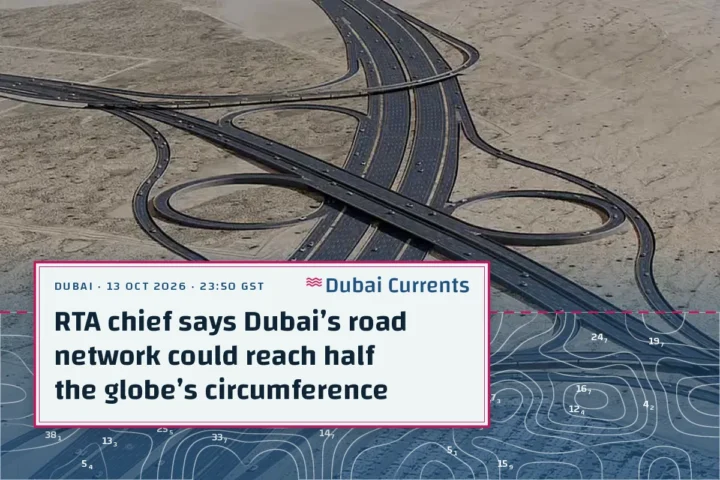
Published 13 October 2026, 9:11 PM – At the Mohammed bin Rashid Leadership Forum, Mattar Al Tayer, Director General and Chairman of the Board of Executive Directors of the Roads and Transport Authority, said Dubai’s road network, if laid end to end, would stretch nearly halfway around the globe.
Current Traffic Volumes and Future Demand
The emirate records over 11 million road trips each day, which works out to roughly 7,000 trips every minute.
Officials say more than six million people who move around Dubai during the day could see that number double by 2040.
“Behind every trip is time from a person’s life. This is where our responsibility begins: keeping mobility flowing smoothly in a rapidly growing city and anticipating its needs before they become challenges.”
Historical Challenges and RTA’s Formation
Before 2005, the road and transport network struggled to keep pace with rapid urban expansion, facing congestion, limited access, economic losses and road fatalities.
In response, Dubai’s ruler Sheikh Mohammed bin Rashid Al Maktoum tasked Al Tayer with preparing a comprehensive study within two months. He recalled the directive’s outcome: “It was completed in half that time, and the RTA was established less than a month later with a Dh75‑billion budget approved by the ruler.”
Since its creation, RTA‑led projects have added Dh156 billion to Dubai’s gross domestic product and delivered more than Dh319 billion in savings through reduced travel time and fuel consumption.
Future Mobility Initiatives
The authority is studying an integrated underground transport system designed to move people, goods and services, aiming to boost efficiency, sustainability and open new investment avenues.
Al Tayer envisions Dubai’s transport as a three‑dimensional network that operates across the sky, ground level and underground, citing ongoing work on the Dubai Loop, the Metro Gold Line and various global technologies that could improve use of subsurface space.
At street level, the goal is for one in every four trips to be autonomous by 2030; autonomous taxis have already logged more than four million kilometres of travel.
Air mobility is also progressing: trials of air taxis started in 2016, and during the current year Dubai carried out an urban test flight and inaugurated its first air‑taxi station.
The Dh34‑billion Metro Gold Line, unveiled in 2026, forms part of the major infrastructure programme intended to sustain the city’s growth, and Al Tayer stressed that Dubai will keep pushing forward with large‑scale projects even under difficult conditions.
Finally, the RTA is developing 100 artificial‑intelligence tools that, according to Al Tayer, could provide the productive capacity of 500 employees, allowing staff to concentrate on higher‑value tasks.