UAE launches AI concierge Mira to handle government transactions for residents and businesses
By Dubai Currents Staff5 min read
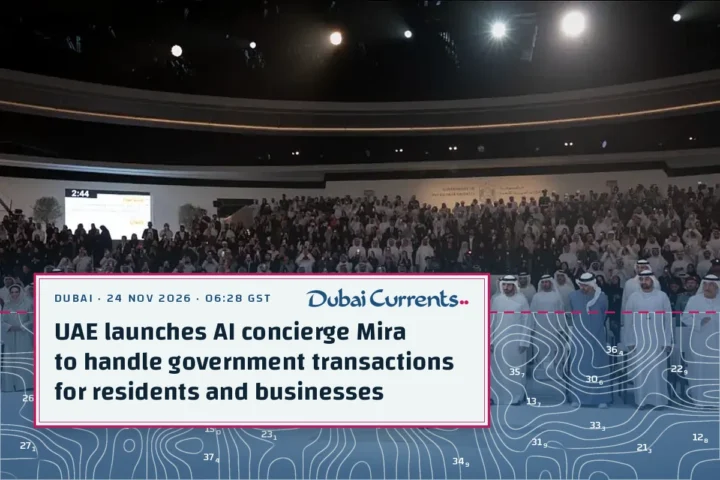
The United Arab Emirates has unveiled an artificial intelligence agent designed to carry out government transactions on behalf of users, moving beyond the question-and-answer function of conventional chatbots. Named Mira, the Government Concierge Agent was demonstrated by ministers at Expo City Dubai on Monday, 24 November 2026.
How the assistant operates
Instead of requiring people to identify the correct authority or application for a given task, Mira works through a natural conversation. Residents describe what they want to accomplish, and the assistant identifies the relevant service, executes the necessary steps, coordinates with the appropriate departments and tracks the request until completion. According to an official guide released with the launch, an initial bundle of services will be available first, with further capabilities added in stages.
Mira differs from standard chatbots because it performs the transactions themselves. Depending on the service, it can review a user’s details, seek confirmation, finalise the procedure and follow the application through to the end. This removes the need to switch between an explanatory bot and a separate website. However, the extent of what Mira can finalise depends on the service type and its availability; some procedures may still require user approval or intervention from the government entity concerned.
Access and eligibility
Users interact with Mira by typing or speaking in everyday language, with no need to know official transaction names or bureaucratic terminology. For instance, a person can simply request a document renewal or a medical appointment, and the assistant will determine the requirements and may ask for a review or approval before proceeding.
The service is intended for citizens, residents, visitors, business owners and companies in the UAE. The specific transactions available to each user will vary according to the service and its prerequisites. Because capabilities are being introduced gradually, not every service will be accessible at launch.
Rollout timeline
Public rollout begins in phases from March 2027, with additional services and features added over time. Officials said all government services will be on the platform before the end of 2027.
Key service categories
Identity and residency services include renewing passports and Emirates IDs, renewing family residency permits and issuing documents for newborns. Users will be able to review their data, complete the process, pay fees and receive documents in line with each service’s requirements. Each transaction appears on Mira only once it has been added, so not all will be present on day one.
Healthcare functions demonstrated include booking medical appointments, selecting specialties and health centres, checking available slots and confirming, changing or cancelling bookings. A video conversation feature lets patients describe symptoms to a virtual medical assistant, which then prepares a summary for the doctor to review before the consultation. The guide emphasises this does not replace a doctor’s assessment or medical advice.
For parents, Mira consolidates children’s grades, exam dates, school behaviour records and alerts in a single conversation, eliminating the need to search across multiple platforms. Students can explore universities and majors, check admission requirements, compare options, submit applications and track their status, moving from search to application without gathering information from separate sources.
Read also: UAE Schools Announce Three-Week Winter Break for 2026-2027 Academic Year
Business owners and investors gain tools to issue and renew work contracts, monitor expiring contracts, update details, pay fees and receive renewed permits. Industrial investors can renew industrial registrations, apply for customs exemptions and obtain value-added certificates. These options will be activated according to the approved rollout phase for each service.
Documents, payments and follow-up
The system aims to reduce repeated requests for the same data and documents. A digital wallet will let users view, store, manage and use their official documents when applying for services, though some transactions may still require additional information. The wallet feature will be introduced gradually.
Mira will provide a unified government payment experience, allowing users to pay service fees without moving between different systems. Crucially, it will not make any payment without the user’s prior approval.
Following up on applications is central to Mira’s design. It helps users start a transaction, complete the required steps and track it until finished. Some transactions may require users to confirm details or supply extra information, and processing times will vary by service. If a service is not yet on Mira, it remains available through existing government channels.
Proactive assistance and future direction
The intention is for Mira to remind users of transactions they may need and suggest the next step before they begin searching. As services develop, it will carry out and follow up on procedures while the decision and approval remain with the user.
Officials have said all government services will be on board before the end of 2027. The goal is for residents eventually to complete their government transactions through Mira without moving between different websites and apps. Until then, people can continue using the usual channels for services not yet added.
Looking ahead, the aim is for Mira to become more like a personal assistant that keeps track of daily needs. It could remind a user that a document is due for renewal, explain the required procedures, then complete and follow up on the available steps after the user approves. As new services are added, residents will spend less time searching for entities and transactions themselves, leaving them “more time for family, work and the things they love”, according to the guide.
What this means for residents and visitors
Mira will begin rolling out to the public in phases from March 2027, with all government services expected on the platform before the end of 2027. The service covers citizens, residents, visitors, business owners and companies in the UAE. Users will interact by typing or speaking in everyday language to request services such as passport and Emirates ID renewals, residency permits, medical appointments, education records, university applications and business transactions. A digital wallet will store official documents, and a unified payment system will process fees only with user approval. Until a specific service appears on Mira, existing government channels remain available.
More in Dubai