UAE startup brings brain training to clients’ homes during Netflix viewing
By Business & Property Desk2 min read
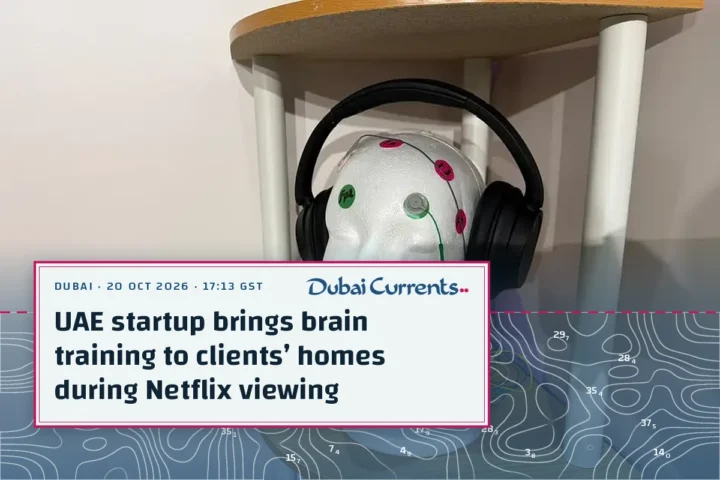
A Dubai-based startup is offering brain-training sessions that allow clients to watch their favourite Netflix shows or YouTube videos while undergoing neurofeedback therapy. McWellness brings its equipment to clients’ homes and uses brain mapping to personalise the experience.
Founder and CEO Shauna McGuinness presented the service at the AccessAbilities Expo 2026, which ran from 19 to 21 October at Dubai World Trade Centre. She explained that the process begins with quantitative electroencephalography, or qEEG brain mapping, using a 23-channel system to record electrical activity through electrodes placed on the scalp.
How the sessions work
Clients receive a detailed report, sometimes around 12 pages, which guides a tailored neurofeedback programme. During a session, they wear headphones and watch a video while software monitors their brain activity. McGuinness demonstrated how the picture on screen shrinks or expands depending on whether the activity meets the training target.
“They just have some headphones on, watch a video, like a Netflix show or YouTube, anything that they enjoy and they think they’ll be engaged with,” she said. The process involves no electrical stimulation and requires little conversation. McGuinness said she regularly pauses to ask whether clients feel focused, relaxed or sleepy, and adjusts the session accordingly.
Case study: ADHD
Among her clients was a 12-year-old boy diagnosed with attention-deficit/hyperactivity disorder, or ADHD. McGuinness said he initially struggled to relax but became calmer and was able to focus better at school during the programme. He stopped taking medication after six sessions and subsequently completed a 25-session package, with plans to continue for additional support.
“He’s just finished the package, but he’s actually going to continue because there’s still some areas that he wants help with,” she said. The article notes that this does not demonstrate that neurofeedback can replace prescribed treatment, and medication changes should be discussed with the treating clinician.
Scientific caveats and client base
McWellness works with children, adolescents and adults, including people with ADHD and autism, and clients seeking support for anxiety or sleep difficulties. However, the services are not intended to diagnose, treat, cure or prevent medical or psychological conditions. A 2025 JAMA Psychiatry review found no significant improvement in overall ADHD symptoms on probably blinded assessments and did not support neurofeedback as a stand-alone ADHD treatment.
Home visits and founder’s background
McGuinness said the home-visit business launched in August, with about 10 clients undertaking packages and others choosing brain mapping alone. She has three years’ neurofeedback experience, studied psychology for four years and later trained in London. Her own mental-health difficulties influenced her interest in wellbeing.
“My goal was to help people in the UAE because this is home to me. I grew up here,” she said. “I love Dubai, and I just wanted to give back to the people here as much as possible.”