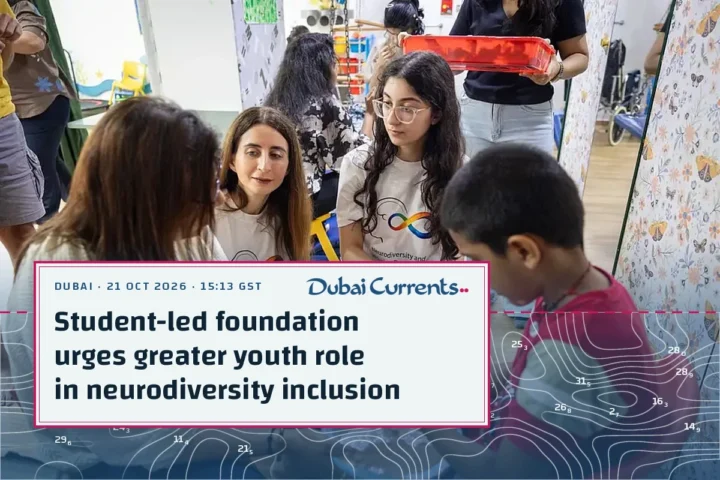
Student-led foundation urges greater youth role in neurodiversity inclusion
By Dubai Currents Staff3 min read
In a commentary published on 21 October 2026, student Syrah Anand argued that young people must be given a greater role in shaping conversations about neurodiversity and inclusion. Anand, who has lived and studied in Dubai and the United States and has strong roots in India, is involved with the India Neurodiversity and Inclusion Foundation.
Early Conversations and the Birth of a Foundation
Anand recalled that some of her earliest discussions about inclusion took place before she even knew the term. Growing up in Dubai, she would hear her mother talk about a teacher she had met, a family seeking support, or an incident in a classroom in India. Her mother had spent years working with children with autism, ADHD and dyslexia, as well as their families and teachers.
At first, Anand said she mostly listened. As she grew older, she began asking a different question: what could she do? Those conversations eventually evolved into something she and her mother decided to build together: the India Neurodiversity and Inclusion Foundation. What interested her most, she wrote, was the role young people could play.
Why Students Must Be Part of the Conversation
Anand noted that much of the discussion around neurodiversity takes place among adults: parents, teachers, therapists, specialists and policymakers. While all those voices matter, she believes students also need to be included. “We are the ones sitting next to one another in classrooms. We are the ones working together on projects, playing sport, eating lunch together and deciding, sometimes without even realising it, who gets included and who does not,” she wrote.
She said inclusion can seem like a very big idea, but at school it often comes down to small moments: who gets invited into a conversation, whether someone is given extra time to answer, whether students mock someone for behaving differently or pause to wonder why they may be struggling, and whether a student feels they must hide the way they learn or communicate to fit in. Working on the foundation, Anand said, has made her notice those moments more.
Different Perspectives and the Importance of Small Gestures
Anand explained that her mother approaches inclusion through years of experience with families, teachers and children, while she approaches it as someone still in school. They do not always see things the same way, and she finds that useful. She tells her mother what she observes among her peers: how quickly students can label someone as “weird”, “awkward” or “different”, sometimes without understanding the behaviour behind it. Her mother shares what she hears from parents and teachers, and how difficult it can be for families when a child is misunderstood.
“Together, those perspectives have made me realise that inclusion cannot only be something adults design for young people. Young people have to help create it too,” Anand wrote.
Living between the United States, Dubai and India has reinforced this insight. In some communities, families have access to specialists, school support and growing awareness of neurodiversity. In others, parents and teachers are still struggling to find basic information about autism, ADHD or learning differences.
Anand stressed that while resources may differ, attitudes matter everywhere. A school may have excellent programmes and policies, but real inclusion also depends on what happens between students when no adult is watching. That is why she cares about making conversations about neurodiversity easier for young people to have. “We do not need to become experts. We just need to become more curious about one another, less quick to judge and more willing to understand that people can think, learn and communicate differently,” she wrote.
Anand said she and her mother still talk about the foundation across time zones. She calls from New Hampshire; her mother answers from Dubai. They discuss what to do next, what needs to change and what they are learning. The difference now, she said, is that she is no longer simply listening to her mother talk about her work. “I have a voice in the conversation now. And if we want the next generation to build more inclusive schools and communities, I think more young people need to realise that they have one too,” she concluded.