Dubai gold prices drop Dh2 per gram in early Tuesday trade
By Dubai Currents Staff1 min read
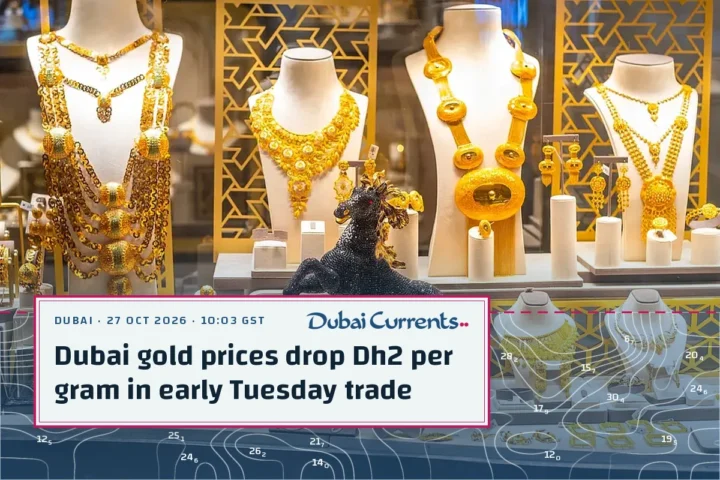
Gold prices in Dubai eased during early trading on Tuesday, shedding Dh2 per gram and reversing the gains recorded the previous day.
Data from the Dubai Jewellery Group showed 24K gold opening at Dh483.25 per gram, down from Monday’s close of Dh485.25 per gram.
Other purities also declined: 22K traded at Dh447.50 per gram, 21K at Dh429.25 per gram, and 18K at Dh367.75 per gram.
Global benchmark falls
On the international front, spot gold slipped 0.4 percent to $4,007 an ounce, while silver dropped 1.7 percent to $53.30 an ounce.
Analyst cites competing pressures
Naeem Aslam, chief investment officer at Zaye Capital Markets, said gold was struggling to hold the psychologically important $4,000 level despite rising geopolitical uncertainty.
He pointed to recent statements by US President Donald Trump concerning Iran, which included the possibility of further military action, claims of control over the Strait of Hormuz, and the alternative of negotiating a diplomatic agreement. These developments, Aslam said, have heightened concerns about global energy security.
However, rather than generating sustained safe-haven demand, these events are exposing gold to competing pressures from rising oil prices, inflation expectations, and elevated US Treasury yields.
Aslam noted that the relationship between geopolitical tensions and monetary policy is becoming increasingly important for gold price movements. Further disruption to Middle Eastern energy supplies could push crude oil prices higher, increasing transportation costs, corporate expenses, and consumer inflation expectations.
This would complicate the Federal Reserve’s ability to ease monetary policy, potentially supporting the US dollar and keeping real interest rates elevated. Such conditions increase the opportunity cost of holding non-yielding gold, even when geopolitical uncertainty encourages defensive positioning.
Conversely, Aslam added, meaningful diplomatic progress involving Iran could ease concerns about energy supplies, reduce inflationary pressures, and improve expectations for future interest-rate cuts.