Dubai summit hears four CEOs share how loss, motherhood and empathy shaped their leadership
By Dubai Currents Staff4 min read
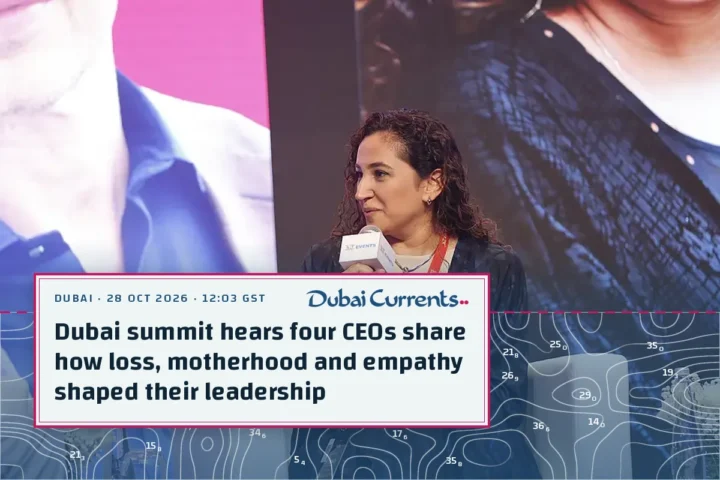
Four women chief executives told an audience in Dubai on Wednesday that the most formative lessons of their careers came not from boardroom strategy but from personal loss, raising children alone and making split-second decisions at a patient’s bedside. Speaking at the inaugural Khaleej Times Women’s Power Summit, the leaders described how those experiences shaped their approach to running organisations.
The panel, titled How Today’s Women Leaders Are Building Tomorrow’s Legacy and moderated by Ted Kemp, chief content officer at Khaleej Times, brought together senior women from across industries to discuss the changing nature of leadership in the UAE.
Loss and perspective
Ahlam Bolooki, chief executive of the Emirates Literature Foundation, said the death of her mother forced her to rethink what mattered in life and work. “It shows me that every single day is a gift and so, what is it that I want to do with my life while I’m here? That’s an important thing to think about,” she said.
That outlook, she explained, shifted her focus from personal ambition to contribution. “When I think of myself as a leader, it’s never about the job title or where I want to get to next. It’s about what the world needs and how I can try to make it happen. That’s how I lead. That’s how I think about every single day.”
From cardiac nurse to chief executive
Kimberley Pierce, chief executive of King’s College Hospital London – Dubai, began her career as a cardiac nurse. She said the demands of critical care taught her to make rapid decisions and constantly reassess priorities based on patient outcomes. “If you take the role of a nurse, particularly in a critical care environment, what happens is we make rapid decisions really quickly based on what the patient’s status is. We have to constantly evaluate, reprioritise, change what we’re going to do based on what we’re seeing in the outcomes.”
Pierce said her clinical background gave her an understanding of frontline challenges that has proved valuable as a chief executive. “That knowledge has really helped me as a CEO because it allows me to understand what the people are doing on the ground, but most importantly have empathy towards the nurses and the doctors and the challenges they face every day.”
Human skills in the age of AI
Alice Weightman, founder and chief executive of Hanson Search Group, said leadership expectations had shifted markedly in the past 25 years. “As a leader, I’m constantly evolving but what stays the same is my values. Values are really important,” she said. “When I set up my business 25 years ago, the style of leadership was much more command and control. Whereas, now the world has evolved and those softer skills are so important.”
Weightman argued that as artificial intelligence transforms workplaces, traditionally female qualities such as empathy and connection will become more valuable. “In the world of AI, human interaction is going to be so much more important as well. So these qualities that we have as women can really excel and can really shine through.”
Authenticity and balance
Katy Keenan, chief executive of the British Chamber of Commerce Dubai, said authenticity was central to her leadership, even when it clashed with corporate norms. Reflecting on her time in financial institutions, she said a more human style was not rewarded. “In my experience in financial institutions, soft leadership or more human leadership didn’t seem to get promotions. So I left.”
Keenan, a mother of two teenage daughters, said she had learned to be fully present in each role. “Each day is about being present in that moment. When I’m in a meeting or I’m on a podcast, I am absolutely present as a leader. Same goes for when I’m with my daughters. I won’t take a call when they’re there. They won’t let me anyway (laughs).”
She also emphasised the importance of self-care. “My Sundays now are so sacred to me. I do sound healing, which is just incredible. It’s an hour just for me and then it resets me to be able to give my best throughout the rest of the week. If I don’t do it, I feel the difference.”
Bolooki added that artificial intelligence could fundamentally reshape work and leadership, offering the next generation a chance to define their own path. “We’re at the brink of change and life as we know it is about to be completely different. The next generation are going to define what leadership is for them. And they have a real opportunity with AI to actually maybe not put in the same hours that we did, but think smart, think efficiently and build skill sets that will allow them to still make the same money, and maybe more.”