Aridge advances flying-car plans for UAE with Ras Al Khaimah sandbox
By Dubai Currents Staff2 min read
Aridge, one of Asia’s largest flying-car firms, announced it is moving toward test flights in the United Arab Emirates as early as the start of 2027, pending completion of a regulatory sandbox in Ras Al Khaimah. The update came from Michael Du, the company’s chief financial officer, speaking to Khaleej Times on the sidelines of the Dubai Business Forum in Shenzhen, China.
Testing and Certification Progress
Aridge expects to begin test operations in the UAE at the beginning of 2027, provided the details of its Ras Al Khaimah regulatory sandbox are settled and logistics for bringing the aircraft into the country are arranged. “The core is really about not only the product, but actually the operational environment,” Du said, explaining that authorities would need time to establish rules for operating the new aircraft. He said the programme would roll out gradually over the next six to twelve months, allowing local officials to develop procedures and adapt existing regulations to advanced air mobility.
Regulatory Sandbox in Ras Al Khaimah
Last month Aridge signed an agreement with Ras Al Khaimah to establish a regulatory sandbox that would permit intensive testing of the flying car before it is made available to the general public. “The sandbox is actually a solid path leading up to the final delivery of the commercial product,” he said. Du noted that Ras Al Khaimah was chosen as a starting point because its lower population density compared with Dubai offers a safer environment for early flights. The company ultimately aims to expand across the UAE, with demonstration routes linking emirates such as Abu Dhabi and Ras Al Khaimah.
Vehicle System and Market Outlook
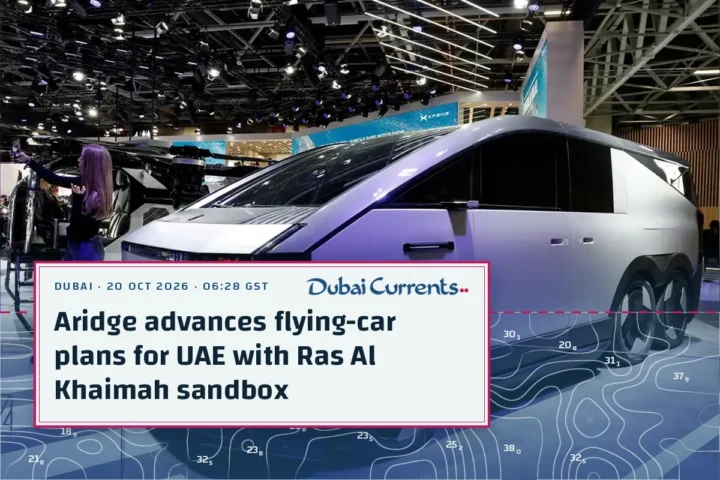
The Land Aircraft Carrier consists of two components: the aircraft module and the ground vehicle it sits on. Users can drive to a location, park and then take off in the aircraft for short trips. Aridge markets the system as a modular flying car intended for personal and recreational use. Du said consumer deliveries could start in late 2027 under an ideal scenario, although the schedule might slip into early 2028 depending on how quickly the regulatory framework and operating environment evolve. He added that the firm had already gathered more than 300 early‑stage orders by last year and believes annual output could eventually reach several hundred units, possibly approaching 1,000, though the product has not yet been actively marketed for sale in the Emirates.
Future Expansion and Larger Aircraft Concepts
The X3‑F aircraft module has completed the authority’s test flights in China but is still awaiting its final type certificate. Du said the Land Aircraft Carrier is likely to reach the market sooner than the company’s larger electric aircraft, which are designed for longer city‑to‑city journeys. He also outlined a separate model, the A868, that can carry up to six people including a pilot, claims a range of 500 kilometres and a top speed of 360 kilometres per hour, and could serve routes such as Dubai to Abu Dhabi, a segment that overlaps with other developers of electric air taxis. Unlike those larger craft, the Land Aircraft Carrier is intended for shorter recreational flights and could help authorities gain experience in regulating and operating advanced air mobility services before more complex aircraft are introduced.
The article was published on Tuesday, 20 October 2026 at 05:58.