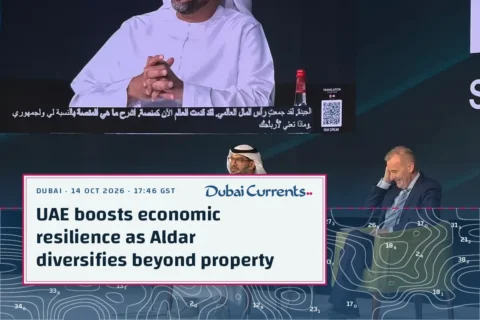
Emaar founder predicts UAE will emerge stronger after regional conflict
By Dubai Currents Staff2 min read

Outlook and Resilience
At the Rise summit in Dubai, Emaar founder Mohammed Alabbar asserted that the ongoing regional conflict will subside and that the UAE and the broader region will come out stronger. He spoke to a packed audience on Wed 14 Oct 2026 at 6:51 PM.
He noted that the Middle East has repeatedly faced turbulent periods, quoting: “History will tell you that the whole world lives through unstable, turbulent times,” he said. “Typically, through catastrophes, people become better. Leaders become better. Environments become better because we learn.”
Alabbar cited the UAE’s track record during previous shocks, mentioning the 2008 financial crash, the September 11 attacks and the Covid-19 pandemic. He added: “That was an unbelievable performance. That’s a test of the system- how resilient it is, how it was built, how it reacts,” he said.
Readiness and Business Indicators
He said the country’s current preparedness had surprised many. Quote: “We didn’t even know anything about defense systems, but we learned and that’s just incredible,” he said. “We were shopping, going to our restaurants. People talk about the closed Hormuz Strait entrance, but we feel nothing. Business is rolling. Growth is not too bad while we go through this situation. And everyone I speak to are confident and feel safe here.”
Turning to Emaar’s operations, Alabbar revealed that the developer normally sells about 4,000 units each month with roughly 600 cancellations, but during the conflict cancellations rose to 1,200 units before dropping back under 600. He remarked: “Don’t tell me how this happened, but what’s happening is that customers are buying the most expensive product in their lifetime,” he said. “The direction is good.”
He disclosed that the firm’s pre‑sale backlog stands at approximately Dh170 billion and that purchasers continue to meet payment schedules comparable to those seen in 2025, despite the difficult climate.
Sales Performance and Pricing Stance
Alabbar acknowledged that sales volumes are weaker than before and that hotel occupancy hovers between 60 and 65 percent, which he described as strong but below the 20 to 30 percent growth recorded in recent years. He said: “We were spoiled,” he said. “But we’ve got good reserves. We can wait.”
He also rejected the idea of deep discounts, noting that while some developers have trimmed prices by 5 to 15 percent, he would not offer a 30 percent reduction to new buyers out of fairness to existing customers. Quote: “To be fair to my customer who bought an apartment in this building, I can’t give 30 per cent discount to the newcomer,” he said.
The outlet encourages readers to follow its WhatsApp channel for updates.