UAE launches $1 million AI award and global future opportunities centre at WEF Dubai
By Business & Property Desk2 min read
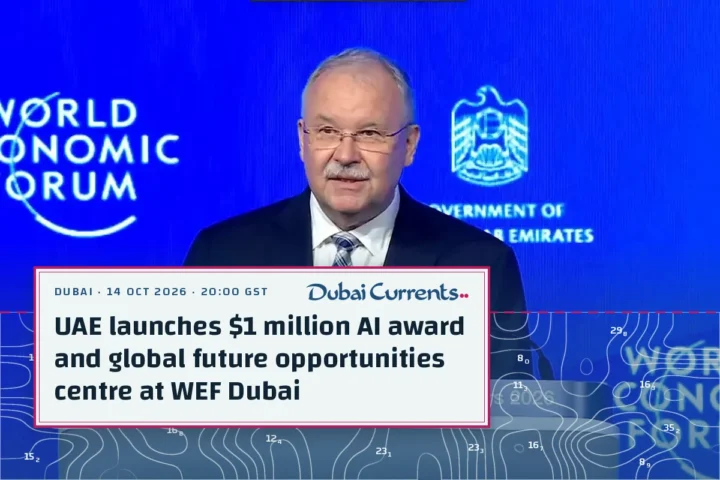
According to a notice published Wed 14 Oct 2026, 12:45 PM, at the World Economic Forum’s Annual Meeting of Global Future Leaders in Dubai, Mohammad bin Abdullah Al Gergawi, UAE Minister of Cabinet Affairs, announced three initiatives aimed at moving the world from discussing AI to shaping the future.
Initiatives announced
The first initiative is the Centre for Global Future Opportunities, a joint project of the UAE government and the WEF, described as the first of its kind to turn economic opportunities into legislation.
The second is the Global Innovation Challenge AI Award, created with Dubai Municipality, offering a $1 million prize for intelligent solutions that improve urban services; the winner will be named next year to illustrate how one city can serve as a model for others.
The third initiative, named Future 20, will spotlight 20 leaders under the age of 30 who have the potential to drive major transformation over the next two decades.
Leadership vision
Speaking at the plenary session, Al Gergawi said the UAE was moving “from discussing the future to shaping it”. He added that eighteen years ago the forum asked how to prepare for the future, while today it asks how to lead it, noting that the rules of change have changed.
He explained that a single economic decision in one capital can affect millions of lives, a cyberattack can disrupt national services, and technology can reshape any economy.
Alois Zwinggi, President and CEO of the World Economic Forum, also delivered a keynote address at the event on Wednesday.
Global transformations
Al Gergawi outlined three major transformations facing the world. First, a shift in the global balance of power: more than 60 armed conflicts were recorded in 2025, the highest number since 1946, and global military spending reached $3 trillion, the highest since the end of the Cold War.
He warned that trade restrictions are redrawing supply chains and manufacturing, and global debt is approaching 94 per cent of GDP, projected to hit 100 per cent by 2029, limiting governments’ capacity to invest in the future.
The second transformation concerns human capability and technology: if technology can invent and produce new machines and tools, the human role and skills in innovation must be redefined.
The third transformation relates to resources and energy: the planet has just experienced its ten warmest years, yet renewables supply 80 per cent of additional global capacity; previous generations lacked such solutions, and progress depends on turning transformation into reality.
He identified five qualities essential for new leaders: the ability to anticipate change, continuous learning and adaptation, wisdom, the ability to build partnerships, and the ability to turn vision into results.
Leadership, he said, is ultimately measured by its impact on people’s lives.