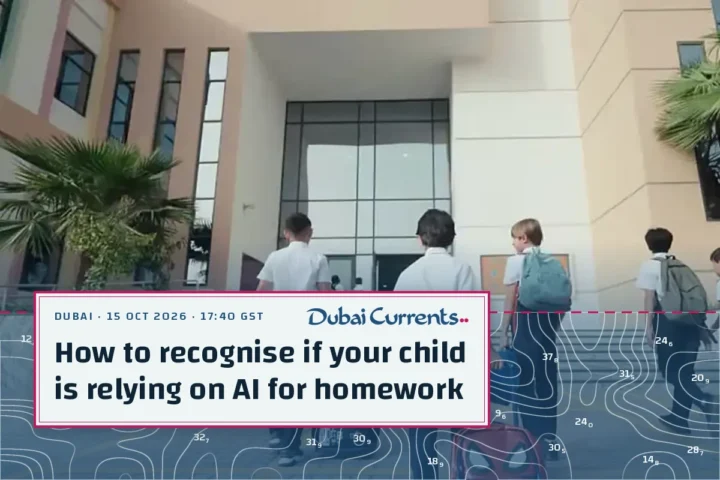
How to recognise if your child is relying on AI for homework
By Business & Property Desk5 min read
Published on Thu 15 Oct 2026 at 5:16 PM, Khaleej Times reports that as Dubai prepares AI guidelines for schools next year, educators across the UAE urge parents to look beyond polished assignments and ask children to explain their thinking, research and problem‑solving.
The article belongs to Khaleej Times’ Schools and Parents section, a dedicated series designed to help UAE families navigate educational choices by offering explainers, guidance from education leaders, expert advice and parent insights to support informed decisions about schools, curricula and communities.
Children across the UAE are increasingly turning to artificial intelligence for homework, revision and school projects. While tools such as ChatGPT make finding answers easier, parents face a key question: are youngsters using AI to learn, or are they letting it do the thinking for them?
Dubai’s Knowledge and Human Development Authority (KHDA) expects to introduce specific guidance on AI use in schools next year, aiming to balance educational benefits with safeguards against inappropriate use.
“We want to have a very clear direction on the use of AI and technology,” said Aisha Miran, KHDA director general. “The whole intention is when is the right time to use it to strengthen student learning, and when they should be careful about using it.”
Stay up to date with the latest news. Follow KT on WhatsApp Channels.
Identifying AI use in assignments
Educators note that a mismatch between the quality of a submitted assignment and a child’s ability to explain it can be an early indicator of AI reliance.
“AI tools are becoming more sophisticated, and we cannot rely on detection software alone to determine whether a student has used AI,” said Zaineb Mahdi, director of innovation and technology at GEMS School of Research and Innovation.
Teachers who know their pupils well may spot shifts in vocabulary, writing style or level of understanding, but Mahdi argues that asking children to explain their work is more revealing than judging the final product alone.
“One of the most revealing questions we can ask is a very simple one: ‘Can you explain how you arrived at this answer?’” she said. “We want students to demonstrate their thinking, explain their decisions and show how their ideas have developed.”
Mahdi adds that schools should place greater emphasis on the learning process—creativity, reasoning and problem‑solving—rather than judging pupils solely on the end result.
“Our teachers know their students incredibly well, so a change in vocabulary or writing style might prompt a conversation, but that alone doesn’t mean AI has been used,” said Thomas Kinnersley, principal of Nord Anglia International School Abu Dhabi. “Asking children to talk through their ideas, show how they reached an answer and explain their thinking helps us see the learning behind the work.”
Assessing independent skills
A practical test for parents is to ask the child to explain a completed assignment without opening the chatbot, to see whether the thinking behind the answer can be reproduced independently.
“The most useful test is simple, switch off the AI and see what your child can do independently,” said Andreas Hassell, founder and chief executive of Ombori.
“Can they explain the answer in their own words, walk you through how they arrived at it, or solve a similar problem without assistance? If they can submit an impressive assignment but struggle to explain it, that is a signal worth paying attention to.”
Parents can apply this approach without turning homework into an interrogation—for example, by requesting an explanation of one essay paragraph, a demonstration of a maths method or a description of why a particular project argument was chosen.
The goal is not to catch children out but to verify whether they have grasped the material.
“Completing the homework is not the same as understanding it,” said Thomas Kinnersley.
Abdulaziz Ahmed, a digital design teacher at Swiss International Scientific School Dubai (SISD), notes that the school teaches AI literacy alongside digital literacy in its secondary curriculum, helping pupils grasp both the opportunities and limits of the technology.
Ahmed explains that AI can assist students in exploring ideas, challenging arguments, identifying gaps in their thinking or obtaining feedback on a draft, but learners still need to conduct their own research, develop arguments and justify decisions.
“The line is crossed when a student simply asks AI to complete an assignment and submits the response as their own,” Ahmed said.
“At that point, they are missing the critical thinking, creativity, and problem‑solving that make the learning process valuable.”
Grade 7 student Yahiya Mohammed turned to ChatGPT after missing two weeks of classes before the summer break while travelling home. Despite speaking to classmates and friends, some topics remained unclear, so he entered them into the chatbot and asked for simpler explanations.
“That really helped me understand them and catch up with what I had missed,” he said.
This example shows how AI can support learning when it aids comprehension of difficult material rather than merely supplying finished answers.
Layla Hassan said her daughter also sometimes uses ChatGPT when she gets stuck on homework, especially when no adult is nearby to help.
“If she doesn’t understand something, she turns to ChatGPT for an explanation or to clear up her doubts. It’s especially helpful when there’s no adult around to help her,” she said.
“AI gives children answers straight away, but they may lose out on the experience of researching, trying different approaches and figuring things out on their own,” she said.
“I feel that struggle and toil have their own value because they are part of the learning process.”
Guiding responsible AI use
Experts advise that parents do not need to ban AI outright; instead, they can set clear expectations about when a chatbot may be used and what information should never be shared.
“Agree what never goes into a chatbot: full names, addresses, photos, passwords and private worries. And follow the school’s rules on AI use,” said Andreas Hassell.
Hassell said younger children needed closer supervision, while older students could gradually be given more independence alongside clear rules.
He also recommends watching for patterns that reveal whether a child attempts a problem independently before turning to AI.
“Does the child attempt a problem before turning to AI, or is the chatbot always the first stop? Do they question its answers?” he said.
Parents can ask where a fact originated, whether the original source can be located and how to judge its trustworthiness.
A child who checks sources and compares information is developing research skills, whereas simply accepting a chatbot’s answer can leave them exposed to inaccurate or misleading content.
Abdulaziz Ahmed added that students also need to understand that AI‑generated responses could contain errors and bias, even when they sound convincing.
For families, the message is to encourage children to treat AI as a starting point for learning rather than the final authority.
“Parents should also watch for patterns. Does the child attempt a problem before turning to AI, or is the chatbot always the first stop? Do they question its answers? Ask them where a fact came from and how they would check it. A child who can find the original source, or explain why one source is more trustworthy than another, is learning. A child who says “the AI said so” is not yet. Can they still write, reason and work through a difficult question on their own?” said Andreas Hassell.
“For parents, he added that the most useful question may ultimately be a simple one: “What can your child do with the tool closed?””