Dubai Police Summit Shows AI Can Fill Surveillance Gaps and Spot Threats Instantly
By Business & Property Desk4 min read
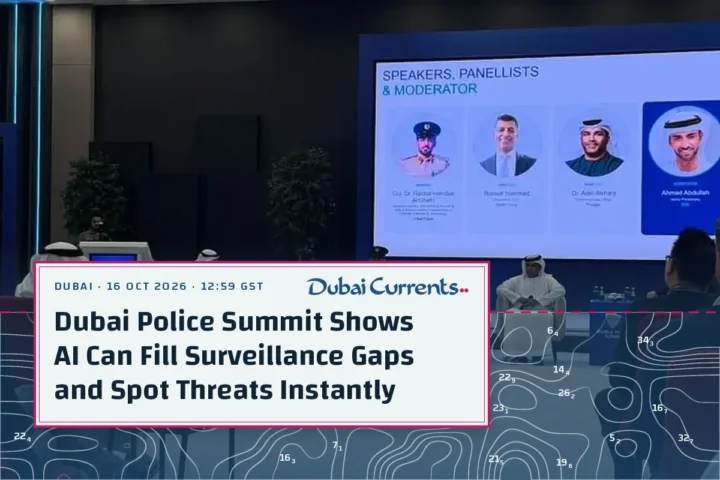
Summit Overview and Cooperation
The World Police Summit hosted by Dubai Police on Friday 16 October 2026 brought together more than 220 speakers and experts to explore 14 topics shaping global law-enforcement challenges.
International police leaders stressed that stronger cooperation is essential to combat emerging threats, noting that no single country can address these issues alone.
They warned that artificial intelligence is altering how criminals operate, compelling police forces worldwide to rethink threat detection, intelligence sharing and response to increasingly sophisticated crimes.
From cyberattacks and financial crime to cross-border criminal networks, agencies must combine advanced technology with international cooperation to keep pace with rapidly evolving threats.
The discussion featured Col. Dr Rashid Hamdan Al Ghafri, Deputy Director General of the General Department of Forensic Science and Criminology; Russell Hammad, Founder and CEO of Zenith Group; and Dr Adel Alsharji, Chief Operating Officer of Presight.
Panellists examined how AI, integrated security systems and real-time intelligence sharing can strengthen policing capabilities.
The summit also hosted over 150 exhibitors and sponsors, providing a platform for law-enforcement agencies, government representatives and technology specialists to exchange expertise and pursue solutions to emerging security threats.
A central message was that only through stronger cooperation between police forces, governments, technology companies and academic institutions can operational gaps be closed and cross-border threats be effectively countered.
Technology Integration Across Domains
Col. Dr Rashid Hamdan Al Ghafri highlighted the value of bringing police leaders from different countries and sectors together to share operational experience, best practices and develop adaptable solutions.
He noted that as criminals exploit digital platforms and international networks, linking information held by various agencies helps investigators spot patterns and connect seemingly unrelated incidents.
The discussion stressed that cooperation must go beyond exchanging ideas; police forces need to integrate systems, share relevant intelligence and coordinate responses so that technological advances translate into practical security outcomes.
Public-private partnerships were described as particularly important because technology companies create tools that support investigations, improve intelligence analysis and strengthen operational capabilities.
Panellists turned to the convergence of physical security and cybersecurity, explaining how integrated surveillance systems and intelligence platforms can help police identify threats more effectively.
Russell Hammad pointed out the difficulties of maintaining security over large geographical areas where conventional surveillance and communications infrastructure lacks comprehensive coverage.
He observed that while urban centres benefit from extensive surveillance networks, remote locations present distinct operational challenges and coverage gaps that hinder monitoring and timely response.
Intelligent surveillance systems and connected patrol vehicles can mitigate these gaps by enabling officers to identify people, vehicles and locations while fusing information from multiple sources.
Such capabilities allow police to build a more complete picture of potential threats and uncover relationships between individuals, vehicles and incidents that might otherwise remain hidden.
The objective is to move beyond isolated systems toward a connected security environment where information can be analysed and acted on in real time.
The discussion also underscored the need to ensure intelligence reaches personnel on the ground; integrating physical-surveillance data with digital intelligence helps officers make better-informed decisions and react more effectively to evolving situations.
AI Use and Intelligence Sharing Priorities
Speakers emphasised that as artificial intelligence becomes more embedded in law-enforcement, investment must extend beyond acquiring new technology.
Police agencies must develop the skills, organisational capacity and infrastructure required to use AI effectively, while ensuring accountability and appropriate human oversight.
Dr Adel Alsharji participated in the dialogue on the challenges facing law-enforcement as technology advances and organisations adapt to new capabilities.
AI-powered systems can process large volumes of information, identify patterns and support intelligence analysis, but their effectiveness hinges on data quality, system reliability and officers’ ability to interpret and act on the generated information.
Forces must also integrate new tools into existing operations and align them with practical security requirements.
The rapid pace of technological development creates an additional challenge, obliging agencies to continually assess capabilities, train personnel and adapt to emerging criminal methods.
The discussion highlighted the importance of responsible technology adoption, with accountability and the human element remaining central to AI use in policing.
When asked which operational gap should receive priority, panellists repeatedly pointed to integration and information sharing.
Connecting systems and strengthening cooperation between agencies enables law-enforcement to use resources more efficiently, improve coordination and respond more swiftly to cross-border crime.
Rapid intelligence sharing is especially vital when threats span multiple jurisdictions or involve several forms of criminal activity.
Panellists also insisted that technology must deliver practical results, giving decision-makers and frontline officers access to relevant information exactly when it is needed.
They warned that fragmented systems and disconnected responses can diminish the effectiveness of advanced security tools, even when individual agencies have made substantial technology investments.
The dialogue concluded with a broader message: governments, police forces and technology partners must function as an integrated ecosystem, combining intelligence, expertise and operational capabilities to confront emerging threats.
As artificial intelligence continues to reshape the security landscape, the future of policing will depend not only on technological innovation but also on agencies’ ability to cooperate, share information responsibly and turn intelligence into timely action.