UAE leads emerging family office hubs with top score and tax advantages
By Dubai Currents Staff3 min read
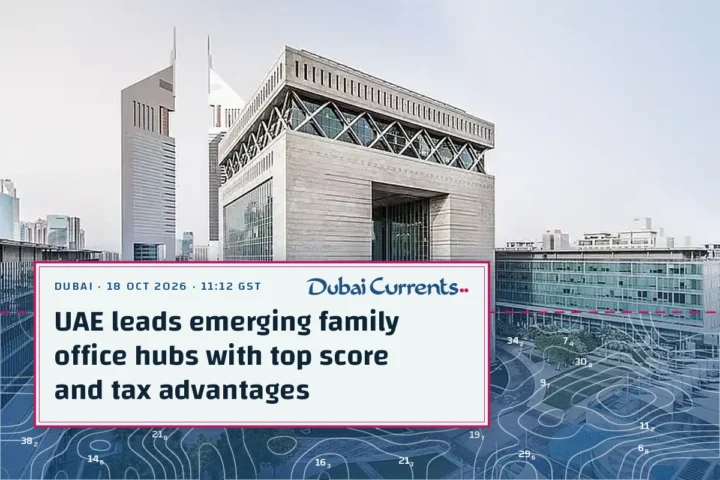
UAE leads emerging family office hubs
The United Arab Emirates has been ranked first among nine emerging centres for family offices worldwide, with a composite score of 74.0, according to a report released by Global Citizen Solutions on Sunday, 18 October 2026 at 10:11 AM. The score surpasses four of the eight established hubs, namely the United States, the United Kingdom, Liechtenstein and Monaco. The assessment keeps emerging and established groups in separate rankings.
Tax regime and ecosystem scores
The study, titled “Family Offices: Best Jurisdictions Worldwide” and produced by the London‑based firm’s Global Intelligence Unit, evaluates 33 jurisdictions on what they provide to the family office structure and to the family behind it. The Emirates achieved a perfect 100 for regime and tax, and a score of 78 for ecosystem and centre depth – the highest ecosystem rating among emerging centres and better than five of the established ones. Dubai is listed as the world’s seventh‑ranked financial centre. The UAE imposes no personal income tax and applies a zero statutory rate when wealth is transferred to the next generation.
Regional peers and global context
At the Dubai International Financial Centre, the number of family‑business‑related entities reached 1,408 by the end of June 2026, marking a 36 % increase over the previous year. In the emerging‑centre tier, Qatar follows the UAE in second place with a score of 66.8 and also records a perfect 100 for regime and tax. Saudi Arabia sits eighth among emerging centres with a score of 47.1 and a regime‑and‑tax rating of 30.
Industry outlook and expert commentary
The report’s central thesis is that favourable terms open the door for a family office, while a strong ecosystem keeps it open. Terms can be adjusted within a budget cycle, but building the supporting industry typically takes a decade. Only six of the 33 jurisdictions exceed the median on both the regime/tax and ecosystem measures, and among those, Singapore is the sole jurisdiction with a purpose‑built family‑office framework. The authors note that this drives families to spread their activities across multiple jurisdictions rather than rely on a single one.
Data from the UBS Global Family Office Report 2026 show that 88 % of family offices now hold bankable assets in two or more jurisdictions, a choice motivated by resilience rather than pure return. When looking at the 17 jurisdictions that were ranked, a family whose priority is the office function would consider Singapore, the UAE or Hong Kong, whereas a family focused on status and succession would look at Switzerland, Portugal or Italy. Out of the full set of 33 jurisdictions, 25 provide a pathway to citizenship for foreign families, and 21 of those impose no restrictions and allow dual nationality.
Patricia Casaburi, founder and chief executive of Global Citizen Solutions, said: “We treat mobility as part of a family office’s diversification strategy, not as something alongside it. The reasoning that leads a family to hold assets in more than one jurisdiction applies equally to where its members hold residence and status.”
João Pacheco, head of Institutional Client Relations at the firm, said families were now diversifying their citizenships as well as their assets, and that both decisions were increasingly taken by the same people at the same table.
Deloitte projects that the wealth held in family‑office structures will rise from US$5.5 trillion in 2024 to $9.5 trillion by 2030, with the global count of single‑family offices expected to grow from 8,030 to 10,720.