Gene therapy ends decades of transfusions for UAE man with thalassemia
By Business & Property Desk3 min read
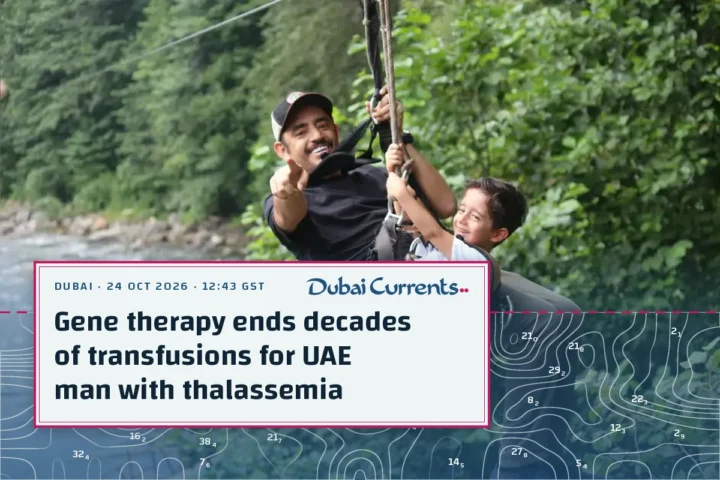
For 43 years, blood dictated the rhythm of Fahad Al Hashimi’s life. The UAE citizen, a father of four, needed transfusions every three weeks to manage the inherited blood disorder thalassemia, which prevented his body from producing enough healthy haemoglobin. To counter the iron build-up, he also spent hours hooked to a pump for iron-chelation therapy.
His energy would peak after a transfusion, only to fade. By the second week, he would feel a drop; by the third, climbing stairs left him breathless. “I would feel like there was no oxygen in the air,” he said.
Despite the condition, Fahad earned two university degrees, worked as a financial auditor in the government sector, and started a family. But planning anything required calculating transfusion dates and energy levels. Even the small pump became a constant annoyance. “There is a needle in your body, and you are going out and doing activities, while people think there is nothing wrong with you,” he recalled.
For years, a bone marrow transplant offered a potential cure, but finding a fully matched donor proved impossible. Testing his parents and siblings yielded no ideal match. A less-than-perfect match carried serious risks.
A new option through CRISPR
At a conference organised by the Emirates Thalassemia Society in Dubai, Fahad met doctors from Yas Clinics who told him about gene therapy using CRISPR gene-editing technology. After extensive assessments, doctors found one complication: the pivotal clinical trial had enrolled patients up to age 35, and Fahad was in his early 40s. Nonetheless, they deemed him eligible.
The treatment was gruelling. He spent about 40 days in hospital isolation, undergoing chemotherapy that weakened his immune system. Eating and swallowing became difficult, and food tasted different. His own stem cells were collected, genetically modified, and returned to his body.
The hardest part was waiting. After discharge, he needed close monitoring. About a month after the procedure, tests showed his blood counts beginning to rise on their own. “For me, it was a dream of my life to see that my body could produce blood,” he said, recalling tears.
Within two and a half to three months, the change became unmistakable. Before, exercise was possible only after a transfusion, and the boost was temporary. Now, Fahad said, he can go to the gym, ride his bicycle, and run whenever he wants. “I can travel whenever I want,” he added, no longer needing to plan trips around transfusions.
Freedom after four decades
For someone who has never lived on a medical schedule, the transformation may be hard to grasp. Fahad now makes plans without checking his last transfusion date or calculating his energy window. The change also reshaped his identity. He no longer has to explain his condition to people who mistook it for cancer or questioned why someone who looked healthy needed regular transfusions.
He urges other thalassemia patients to care for their health, manage iron levels, stay active, and discuss emerging treatments with doctors. Gene therapy is not an easy path, he cautions, given the demands of chemotherapy and recovery. But he believes medicine is advancing rapidly. “Science is always developing,” he said, advising patients to keep asking doctors about new options.
For Fahad, the progress is measured in everyday moments: waking up and deciding to exercise, getting on a bicycle, booking a trip without arranging a transfusion first. And after more than four decades, knowing his body can now produce the blood he once depended on others to provide.