Final bridge at Dubai’s World Trade Centre opens, cutting waiting time to 90 seconds
By Business & Property Desk3 min read
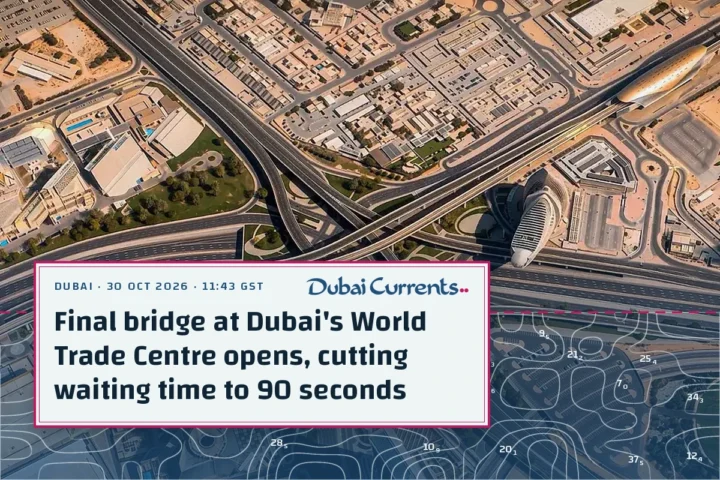
Drivers travelling through the World Trade Centre area will experience a transformed journey as the final bridge of a Dh696-million development project opens on 30 October 2026. The former oval roundabout has been removed and replaced with a surface-level intersection supported by five bridges, designed to reduce average waiting time from up to 12 minutes to about 90 seconds.
Final bridge opens
The last structure, a 1,000-metre two-lane bridge, will carry traffic from Al Majlis Street towards 2nd December Street. It can handle approximately 3,000 vehicles per hour. During a test drive before the opening, the old roundabout was no longer visible; instead, a network of new roads, flyovers, lane splits and exits now dominates the area. The route feels more direct, but drivers need to read signs early and move into the correct lane well before their exit. The project separates traffic heading in different directions rather than allowing all vehicles to converge at one circular junction.
Motorists adjust to new routes
Abdul Qayyum, who regularly drives from Satwa towards Sheikh Zayed Road, said the new layout should make crossing the area easier once drivers become familiar with it. “Earlier, vehicles would build up near the roundabout, especially when people were trying to exit to different directions,” he said. “Now, traffic is being separated much earlier. For the first few days, drivers will need to understand which exit to take, but once they get used to it, it should save a lot of time.”
Another regular commuter, Salam Mulla, said the junction already feels more organised, although motorists cannot rely on their old driving habits. He has been using the new junction for nearly two weeks and said drivers need to decide their route before reaching the interchange. “You have to understand the signs in advance and know where you want to go. Otherwise, you may end up taking a different exit,” he said. “The signs are clear, but you need to keep your eyes on them before reaching the junction. Compared to the earlier junction, this is much easier.” He added that the project’s scale is visible even from ground level. “It has layers of roads. When you are driving at ground level, you can see flyovers going in different directions, including roads above you.”
Five bridges, three main connections
The five bridges extend a combined 5,000 metres and are grouped into three main connections. A 1,000-metre bridge provides a direct route from Sheikh Zayed Road towards Sheikh Khalifa bin Zayed Street for motorists heading to Deira. This two-lane bridge has a capacity of about 3,000 vehicles per hour.
Two other bridges, with a combined length of 2,000 metres, connect Sheikh Rashid Street with 2nd December Street. They provide two lanes in each direction and can carry up to 6,000 vehicles per hour. These routes are expected to help traffic moving between Deira, Al Satwa and Jumeirah.
Another pair of bridges connects Al Majlis Street with 2nd December Street. Together, they also stretch 2,000 metres, with two lanes in each direction and capacity for about 6,000 vehicles per hour. This route is particularly important for motorists travelling between Al Satwa or Jumeirah and the World Trade Centre area. Al Majlis Street connects onwards to Al Mustaqbal Street, serving Dubai World Trade Centre and Dubai International Financial Centre.
Areas set to benefit
The Roads and Transport Authority (RTA) said the development will benefit more than 500,000 residents and visitors. It serves communities including Zaa’beel, Al Satwa, Al Karama, Al Jafiliya and Al Mankhool, as well as people heading to offices, hotels and exhibitions around DWTC and DIFC. For now, the main message for motorists is simple: the roundabout is gone, and the new exits need attention. But once drivers adjust, the junction is expected to become one of the city’s smoother crossings rather than one of its longest waits.