Dubai musical revives Nawab Wajid Ali Shah’s cultural legacy
By Dubai Currents Staff2 min read
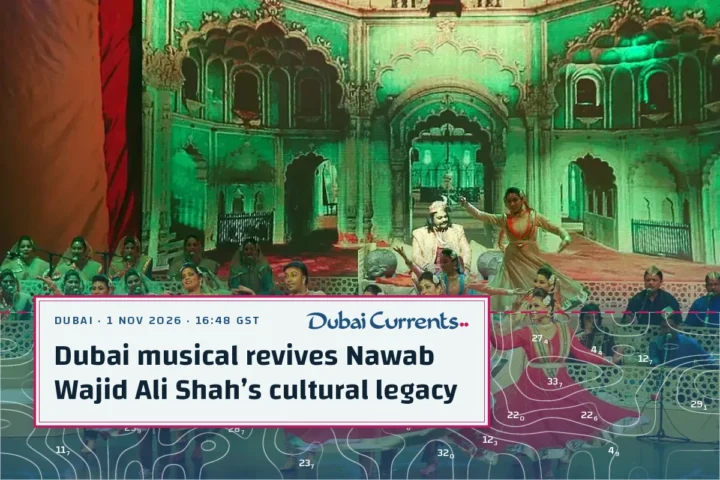
Dubai’s Malhaar Centre of Performing Arts is set to stage a musical production titled Jashn e Awadh on 14 November at the Rajmahal Theatre inside Bollywood Parks. The show celebrates the music, poetry, literature and dance that flourished under the patronage of Nawab Wajid Ali Shah, the last ruler of the historic kingdom of Awadh in northern India.
Nawab’s cultural impact
Shah (1822–1887) is remembered less for his military prowess and more for his epicurean and artistic tastes. He was a secular ruler who blended the Ganga Jamuni Tehzeeb tradition of religious harmony, dressing as Krishna during Janmashtami and celebrating all festivals. He wrote poetry under the pen name Akhtar Piya, invented new ragas and composed songs such as Nirbharan kaise jaun Sakhi and Babul Mora that remain popular today on platforms like Coke Studio.
His love for food also left a lasting mark: dishes such as galouti kebab, roomali roti and the Calcutta biryani—which contains potatoes because his cooks substituted them for meat when the exiled ruler fell into poverty—trace their origins to his court.
Jogiraj Sikdar, founder of the Malhaar Centre, said Shah’s contribution to Hindustani music and dance was enormous. “Kathak prospered under him. Pandit Bindadin Maharaj, the great grand-uncle of eminent Kathak exponent Pandit Birju Maharaj, was an artiste in his court and Shah’s guru,” Sikdar told Dubai Currents.
A contemporary Broadway-style production
Jashn e Awadh was first staged about fifteen years ago and brought Malhaar recognition for blending a Western musical-theatre feel with Indian classical music and dance. This year’s production involves a team of 100 people, with 60 performers onstage. The script is by Prakaash Soni, direction by Sanjeev Dixit of Third Half Theatre, choreography by Vaishali Mhaiskar of Tapasya, and lead vocals by Hafeeza Sultana, a student of Pandit Ajoy Chakrabarty who also teaches at the centre.
Asked why he chose Wajid Ali Shah as the theme, Sikdar cited his own musical lineage. “Lucknow is my musical lineage. My guru Padmashri Rita Ganguly comes from Lucknow. Pandit Birju Maharaj was her neighbour, and so was Javed Akhtar sahab. My nani guru Begum Akhtar is from Faizabad, Lucknow. Awadh is in the same region.”
Classical arts and audience perception
Sikdar acknowledged the support of his wife Mily Chakrabarty, a journalist who managed the household while he focused on Malhaar. On the challenge of sustaining classical forms in a fast-paced world, he said: “There is a difference between a fast-food burger and a shami kebab. A random egg roll off the shelf is completely different from a curated, slow-cooked meal—it is a matter of higher taste and experience.”
He noted that Awadhi cuisine will be served at the venue on 14 November to give audiences a taste of that heritage. Mily Chakrabarty added: “There is a perception that classical music is elitist, so people stay away. But give it a chance, you might be touched by decades of hard work the artists are putting in.”
Sikdar pointed to Bollywood successes such as Bajirao Mastani, Padmaavat and Umrao Jaan as evidence that audiences are interested in classical music and dance forms. “The show is a group effort,” he said. “All the musicians are Malhaar artists.”