Business Updated
GCC economies lose one percent of GDP each month due to regional conflict, Allianz economist warns
By Business & Property Desk3 min read
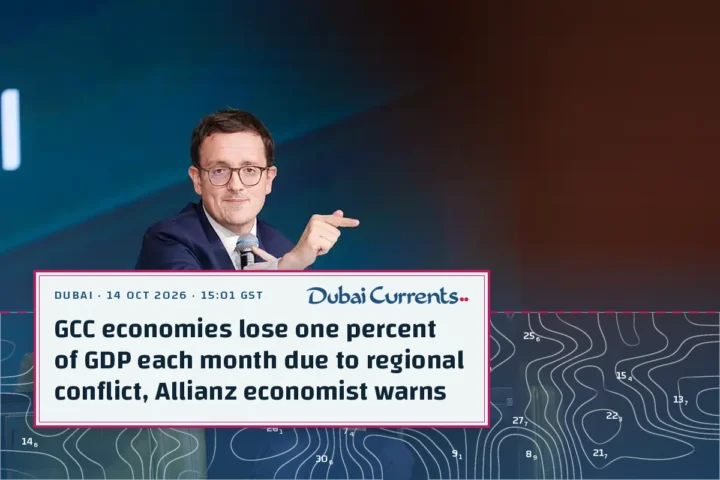
At the Rise summit held at Dubai World Trade Centre on Wednesday 14 October 2026, Allianz Chief Economist Ludovic Subran, who leads the €800 billion asset manager, warned that each month of the continuing regional conflict is shaving off the equivalent of one percentage point of GDP from the GCC economies, urging the region to turn to international markets to finance growth.
Impact of the regional conflict on GCC economies
He opened his remarks by praising the region’s response to the crisis, saying, “I’m here to show that this region has actually already, seven months into the conflict, shown that they are resilient,” and adding, “It’s not how high the buildings are, it’s how resilient the people are.”
What investors look for
Subran told the audience that international investors look for three things before committing more capital: a clear path, bankable projects, and someone to invest alongside. He elaborated, “What this region wants to see is a clear path, very bankable projects, someone to invest alongside, and a clear direction,” he said. “And I think this is what this region has offered through Vision 2030.”
Global trade, AI and US outlook
On global trade, he warned, “Global trade is in recession this year, if you take out AI,” he said. “It’s plus 1 per cent global trade, but it’s actually minus four if you take out AI exports, goods and services.” He added that this single figure shows how much the world economy now depends on one sector, noting, “That tells you how much of the capex on data centres and the AI economy is still the big front-end running factor behind global and US growth.” Regarding the AI boom, he said, “We are 80 quarters into the AI capex boom,” he said. “Historically, capex cycles for technological booms last 24 quarters. So there’s still a few miles left to go.” Turning to the United States, Subran described the US economy as running on a war footing: “The US economy is in war economics. The public sector is running a 7% deficit,” he said. “The corporate sector in the US is going okay, but the public sector is not going very fine.” On interest rates, he predicted the Federal Reserve will be forced to cut, stating, “I still think the Fed will have to cut rates two or three more times in 2027 not to be in recessionary territory,” he said, putting the new neutral rate at around 3%. He also flagged rising credit risk outside the AI sector, warning, “I’m a bit concerned that we start to see fallen angels,” he said, naming Oracle as a company at risk. “The risk of Oracle going fallen angel is very high.”
Where to allocate capital
With the traditional bond‑equity hedge no longer effective, Subran pointed to infrastructure and private credit as alternatives. He said, “I love infrastructure,” he said. “I think infrastructure is resilient throughout the cycle, both on debt and equity.” On gold, he admitted a change in his long‑held view: “I always thought that gold was for weddings,” he said. “But now I understand that gold has a role to play in portfolios because China is using gold to internationalise the RMB.” Regarding real estate, he saw opportunity in the region’s recent correction, noting, “It’s a 10% correction, at least what we’ve seen through September,” he said. “Maybe it’s also a good moment to re-enter.” His final message to the region was simple: keep the vision, and the capital will come.