RTA identifies southern and eastern Dubai as next growth corridors amid population boom
By Business & Property Desk2 min read
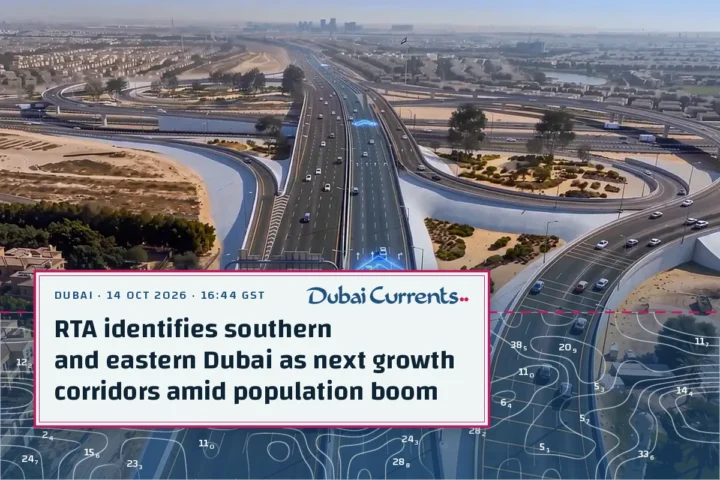
Dubai’s Roads and Transport Authority (RTA) has pinpointed the southern and eastern parts of the emirate as the next areas of concentrated population expansion, driven by the development of Al Maktoum Airport (DWC) and the corridor between Sheikh Mohammed bin Zayed Road and Emirates Road. Muna Al Osaimi, CEO of the Strategic and Corporate Governance Sector at RTA, disclosed the information during the Rise summit at Dubai World Trade Center on Wednesday, which attracted over 600 global investment executives.
Population surge
Dubai’s population has soared from 40,000 in 1960 to 4.8 million today, with the daytime population swelling to roughly 6.5 million due to commuters, tourists, and workers, Al Osaimi said. She described the growth rate as approximately 70 per cent annually in recent years, far above the global average of 1 to 2 per cent. The emirate’s built-up area expanded from 3.2 square kilometres in 1960 to 1,500 square kilometres today.
“We must also meet today’s transport demand while think and plan for the future,” she said. “In 20 years, RTA has tripled its road network to more than 25,000 lane kilometres.”
Public transport gains
The share of journeys taken on public transport rose from 6 per cent in 2005 to over 22 per cent in 2025, Al Osaimi noted. The Dubai Metro, which started with 20,000 daily riders, now carries more than 730,000 passengers per day. “Dubai’s growth creates opportunity for investors and developers,” she said. “In our line of business, we need to understand both the scale and the location where the growth will occur.”
Future growth corridors
Al Osaimi revealed that future growth will be concentrated around Al Maktoum Airport and the area between Sheikh Mohammed bin Zayed Road and Emirates Road. RTA uses land data to model scenarios and prioritise projects. The authority works closely with real estate developers, engaging before master plans are approved. “We advise them on the best solution and connect their development to our future plan and our network. Sometimes we also adjust, accommodate, and help developers and investors reach their vision,” she said. In 2026 so far, RTA has handled 550 traffic impact studies, including over 80 large developments.
Infrastructure investment
Between 2005 and 2025, Dubai invested approximately Dh175 billion in transport infrastructure, contributing Dh156 billion to the GDP and saving residents and businesses over Dh319 billion in fuel and time costs. Al Osaimi outlined private-sector opportunities: a Dh3 billion public-private partnership portfolio in transit-oriented development and an additional Dh30 billion across various projects. Market confidence was evident—Salik was 49 times oversubscribed, Dubai Taxi around 130 times, and Parkin approximately 165 times.
Major rail expansions are underway. The 30-kilometre Blue Line, connecting nine districts and 14 stations serving about one million residents, is scheduled to open in September 2029. The 42-kilometre Gold Line with 18 stations across 15 strategic areas is planned for tender by the end of this year and operation in 2032. “Dubai’s mobility journey extends beyond individual projects,” Al Osaimi said. “We are shaping an integrated, intelligent and resilient network that keeps pace with the city’s ambition.”