Huawei showcases wearable health and imaging advances at Dubai talks
By Dubai Currents Staff4 min read
Making sophisticated health monitoring a routine part of daily life is no small feat for a smartwatch, and neither is giving a phone camera the ability to reproduce colours the way the human eye sees them. Both capabilities rest on years of research, engineering and technological development that continue to reshape expectations of personal devices.
Huawei’s stated goal is to put that research directly into consumers’ hands. The company convened researchers, healthcare specialists and technology experts for two sessions at its recent MEA Tech Innovation Talks in Dubai, covering wearable health technology and smartphone imaging.
The sessions examined the science behind Huawei’s newest products, ranging from wearables intended to support closer monitoring of cardiovascular health to cameras engineered for more natural colour reproduction and sharper detail.
Wearable health takes centre stage
Huawei underlined its expanding emphasis on wearable healthcare, with medical experts and researchers discussing how smartwatches might aid cardiovascular health management and encourage a more proactive approach to wellbeing.
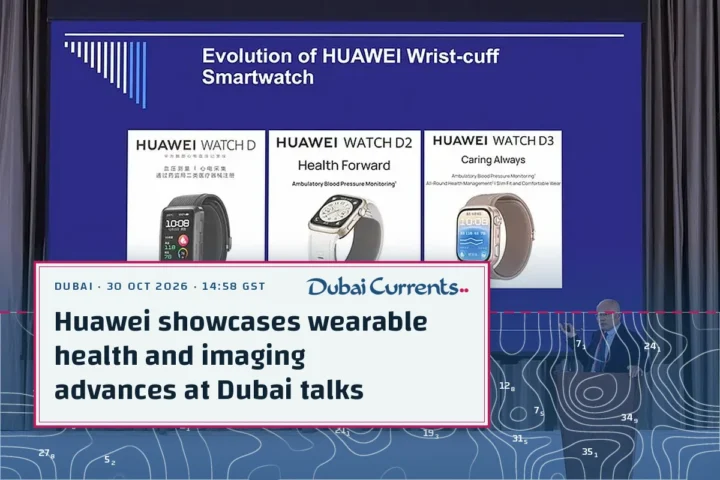
The talks came after the HUAWEI WATCH D3 was unveiled at the ISH-ECS 2026 conference in Dubai, which ran from 22 to 25 October. The device brings medical-grade blood pressure monitoring to the wrist, with the aim of making routine measurements more convenient.
For those who need to check their blood pressure often, convenience matters. Panellists explored how wearables could cut down on the disruption caused by conventional monitoring while still offering useful data on blood pressure patterns.
Professor Jiguang Wang, Professor of Cardiovascular Medicine at the Shanghai Institute of Hypertension, spoke about the HUAWEI WATCH D3’s potential to make blood pressure management a more natural element of daily routines. He cited features including minimally disruptive ambulatory blood pressure monitoring (ABPM) and environmental monitoring reminders as examples of how wearables could make consistent monitoring easier to fit into everyday life.
Professor George Stergiou, President of the International Society of Hypertension (ISH), called the HUAWEI WATCH D3 a novel and reliable wearable device that can offer insights into blood pressure profiles and patterns. He added that the European Society of Hypertension (ESH) and ISH encourage clinical use of validated wrist-cuff blood pressure monitors, while emphasising the need for more research on their application in clinical practice.
Professor Datin Yook-Chin Chia, Professor and Senior Consultant at Sunway University in Malaysia, took up the practical difficulties of ambulatory blood pressure monitoring. She said that fewer disruptions and a smaller number of required measurements could make comprehensive monitoring more manageable for patients.
Huawei’s research goes beyond the smartwatch. Together with ISH, the company has set up the Wearable Blood Pressure Technology Innovation Fund to back further studies on hypertension and its management.
Another topic of growing interest came up in the sessions: using wearable technology to spot diabetes risk at an earlier stage. Professor Maryam Al Saeed of Mohammed Bin Rashid University of Medicine and Health Sciences pointed to a clinical research collaboration between Dubai Health and Huawei that will evaluate non-invasive wearable technology for earlier diabetes risk assessment. The project intends to use real-world health data to examine how wearables could support personalised prevention, enable earlier intervention and improve long-term health outcomes across different populations.
Guests at the event had the chance to test the HUAWEI WATCH D3’s blood pressure monitoring functions, getting a first-hand look at how the technology performs in various scenarios.
Chip research beyond miniaturisation
The conference also offered a window into Huawei’s broader research ambitions. Edwin You, the company’s Chief Technology Officer, discussed Tau Law technology, which takes a different route in semiconductor development. Instead of concentrating only on shrinking transistors, the approach aims to cut the time electrical signals need to travel through chips. Huawei says innovations such as LogicFolding could boost transistor density and system performance, potentially creating new possibilities for future processors.
Imaging: colour, portraits and zoom
A good photo does not depend solely on megapixel counts. Accurate colours, preserved detail and the ability to handle tricky lighting matter just as much. Anyone who has tried to shoot a concert or capture a sunset on a phone knows that the screen does not always reflect what the eye saw.
Huawei is tackling these problems through its XMAGE imaging technology. At its smartphone innovation presentation, the company detailed its work on colour accuracy, portrait photography and optical zoom, areas that continue to define the mobile photography experience.
A central element was Huawei’s True-to-Colour Camera technology, which seeks to reproduce colours more accurately by analysing ambient light. Conventional phone cameras build an image mainly from red, green and blue colour data. Huawei’s system works differently, employing multispectral sensing to capture more detailed information about light and colour. That enables the camera to tell apart colours that could otherwise look similar, especially in difficult lighting.
The technology has gone through three generations. The first generation concentrated on reproducing natural colours; the second improved performance in tougher conditions such as low light, backlighting and mixed light sources. The newest version, True-to-Colour Camera 3.0, focuses on portrait photography, specifically the difficulty of capturing natural skin tones in varied lighting. Huawei’s laboratory data puts the improvement in skin tone restoration capability at 62 per cent.
Huawei also showcased advances in adjustable aperture technology, which gives cameras more control over how much light reaches the lens. That can matter for portraits, landscapes or low-light scenes, offering greater flexibility over focus, exposure and background blur.
Also on show was the XMAGE Z10 Modular Camera, which adds more advanced optical capabilities to smartphone photography. With a 24–240mm continuous optical zoom range and a one-inch 50-megapixel sensor, the system aims to give users more freedom when shooting subjects at various distances. For concertgoers, sports fans or travellers, that could mean switching from wide-angle shots to close-ups of distant subjects without depending on digital zoom.
Durability and foldable design
The presentation went beyond photography as well, touching on Huawei’s work with Kunlun Glass and foldable smartphone hinge technology. These efforts respond to practical concerns about smartphones, above all screen durability and the reliability of foldable designs.