Dubai Updated
Dubai unveils vision for mega-airport, new metro line and Dh100bn finance hub at leadership forum
By Dubai Currents Staff3 min read
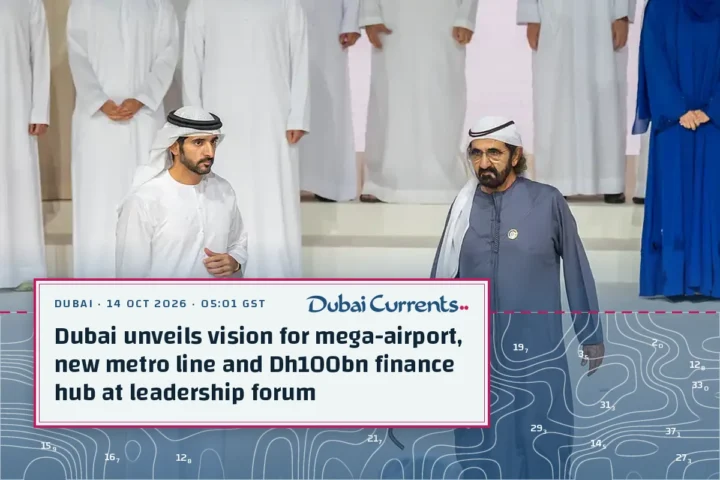
Officials at the Mohammed bin Rashid Leadership Forum 2026, held on 13 October at the Dubai World Trade Centre, presented the emirate’s long-term plans for aviation, transport, trade, finance and urban development. The event brought together government and private-sector leaders to discuss the next phase of Dubai’s growth.
Aviation and transport expansion
Khalifa Al Zaffin described the future of Al Maktoum International Airport, which is designed to handle up to 260 million passengers annually. He said Dubai’s goal was not simply to build the world’s largest airport but to transform the passenger journey through technology and efficient processes. “The best technologies are those that you do not feel,” he said, explaining that innovation should save passengers time and simplify their experience.
Mattar Al Tayer outlined a transport vision covering three dimensions: air, land and underground. Dubai currently records more than 11 million journeys daily, equivalent to over 7,000 journeys every minute. Al Tayer said the city’s daytime population is expected to double by 2040, increasing pressure on the transport network. The Roads and Transport Authority aims for autonomous transport to account for one in four journeys by 2030. Air taxi trials began in 2016, with the first station expected in 2026. The authority is also studying an integrated underground system for moving people, goods and services. Plans include the Dh34-billion Metro Gold Line and using artificial intelligence to boost productivity, with AI-enabled work potentially delivering output equivalent to 500 employees. “Our future projects will not stop, but accelerate,” Al Tayer said.
Global trade and Jebel Ali
Essa Kazim traced Dubai’s commercial growth to early decisions such as the exemption of customs duties in 1901. “Dubai’s success was not a sudden leap; it was an accumulation,” he said. The next phase will build on DP World’s network, which spans six continents and more than 80 countries, employs over 125,000 people and handles around 10 percent of global container trade. The strategy aims to create an integrated network linking Jebel Ali with ports and trade corridors across the region, including the UAE’s east coast, Oman, Syria and Africa. In Syria, DP World has announced an $800-million investment in Tartus Port over 30 years. In Senegal, the first phase of the Port of Ndayane is designed to handle up to 1.2 million twenty-foot equivalent units (TEUs), strengthening trade connections with West Africa.
Financial district and innovation
Kazim also highlighted the expansion of the Dubai International Financial Centre through its Zabeel District, launched in January 2026. The development covers 7.1 million square feet of land, with 17.7 million square feet of gross floor area and an estimated value exceeding Dh100 billion. It is planned in six phases, with the first phase targeted for 2030 and the master plan extending to 2040. More than one million square feet will be dedicated to an innovation and artificial intelligence campus. DIFC Academy aims to serve 50,000 learners annually, while the centre already hosts more than 6,000 technology companies employing around 30,000 technology professionals.
Smart city and tourism
Marwan bin Ghalita outlined Dubai Municipality’s plans under the Life in Dubai 2033 vision, focusing on infrastructure, sustainability and quality of life. After the heavy rains of 2024, Dubai has continued developing its drainage network, which now has a capacity exceeding 20 million cubic meters a day and a network stretching more than 6,500 kilometres. The city is exploring modern construction methods including 3D printing, robotics, modular construction and AI. Plans include increasing the number of trees to 3.5 million and developing green areas and cultivated spaces covering 187 square kilometres. Digital twins, control centres, autonomous cleaning vehicles and AI-assisted food inspections are also part of efforts to improve city management.
Issam Kazim presented Dubai’s tourism vision for 2033, emphasising the city’s identity, infrastructure and overall visitor experience. The approach focuses on ensuring growth is supported by an environment that attracts visitors while maintaining the quality of experiences that define Dubai as a global destination.
Together, the presentations set out a connected vision for Dubai’s future, linking transport and aviation with international trade, financial services, urban infrastructure and tourism.